Every Job Needs a Roadmap: How Better Workflow Management Improves Profitability
Winning the job is only the beginning.
Once the estimate is accepted, the real work starts. Materials need to be ordered, technicians need to be scheduled, customers need updates, invoices need to be sent, and every step has to happen at the right time.
Without a defined process, even profitable jobs can become stressful, delayed, and less profitable than expected.
The contractors who consistently deliver exceptional customer experiences aren't simply working harder—they're managing every job through a repeatable workflow.
Organized Jobs Finish Faster
Every job follows a series of milestones.
For example:
Estimate approved
Materials ordered
Installation scheduled
Crew assigned
Work completed
Quality inspection
Invoice delivered
Customer follow-up
When these steps are clearly defined, everyone knows exactly what comes next.
Instead of reacting to problems, your team proactively moves each job toward completion.
Visibility Eliminates Guesswork
One of the biggest frustrations for contractors is not knowing the current status of every active project.
Questions like these consume valuable time every day:
Has the permit been approved?
Did the customer confirm the appointment?
Have the materials arrived?
Has the technician uploaded photos?
Was the invoice sent?
Has final payment been collected?
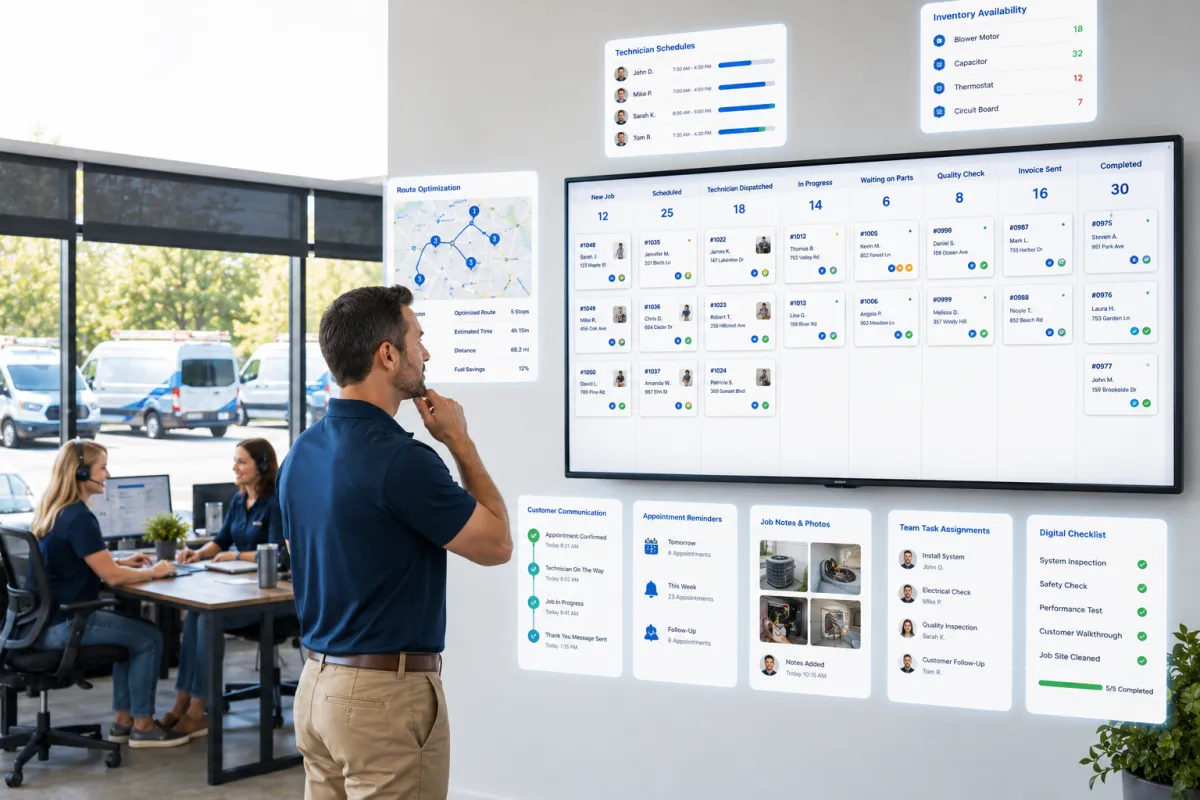
A centralized job management system answers these questions instantly.
Instead of searching through emails, paperwork, or text messages, your team has a real-time view of every job.
Communication Keeps Jobs Moving
Projects often stall because someone doesn't receive the information they need.
Perhaps the office doesn't know a technician finished early.
Maybe a customer isn't informed that materials have been delayed.
Or a technician arrives without knowing the customer's expectations.
Clear communication between office staff, field technicians, suppliers, and customers keeps projects moving without unnecessary delays.
Every Team Member Should Know Their Next Task
Successful businesses eliminate uncertainty.
Office staff know which customers need scheduling.
Dispatchers know which technicians are available.
Technicians know where they're going next.
Managers know which projects require attention.
When responsibilities are clearly assigned, accountability improves across the entire organization.
Small Delays Become Big Problems
A forgotten phone call.
A missing purchase order.
An unscheduled inspection.
A delayed invoice.
Individually, these issues may seem minor.
Together, they can delay projects, frustrate customers, reduce cash flow, and increase operating costs.
A structured workflow helps identify problems before they affect the customer.
Standardized Processes Improve Quality
Every completed job reflects your company's reputation.
Using standardized checklists and workflows helps ensure that every project includes:
Required documentation
Before-and-after photos
Customer approvals
Safety procedures
Equipment registration
Warranty information
Final quality inspections
Consistency reduces costly mistakes while improving customer satisfaction.
Real-Time Updates Build Customer Confidence
Customers appreciate knowing what's happening.
Simple updates such as:
Technician is on the way.
Materials have arrived.
Installation begins tomorrow.
Project completed successfully.
Invoice has been emailed.
These communications reduce uncertainty and create a more professional experience.
Customers rarely complain about receiving too much helpful information.
They often complain about receiving too little.
Measure Operational Performance
The best contractors continuously improve their operations.
Track metrics such as:
Average job completion time
Schedule adherence
Technician productivity
Project profitability
Callback rates
Customer satisfaction
Invoice turnaround time
These insights help identify bottlenecks and improve future performance.
Workflow Creates Scalability
Many contracting businesses reach a point where growth creates chaos.
More jobs.
More technicians.
More customers.
More paperwork.
Without standardized processes, complexity increases faster than revenue.
Documented workflows allow your business to grow without sacrificing quality or customer service.
Better Processes Create Better Businesses
Successful contractors don't rely on memory or heroic effort.
They rely on systems.
When every job follows a consistent process, projects stay organized, teams communicate more effectively, customers remain informed, and cash flow improves.
The result isn't just completed jobs.
It's a business that operates with confidence, consistency, and control.
Ready to Keep Every Job Moving?
REACHMORECRM helps service contractors manage every project from estimate to final payment with centralized job tracking, technician scheduling, automated customer communication, digital checklists, and real-time workflow visibility. When every team member knows what to do next, jobs stay on schedule, customers stay informed, and your business becomes more profitable.